
Madeline House, 12 High Street, SO32 1AA
- Aug 19
- 22 min read
Updated: 1 day ago
Original research by Godfrey Hebdon
Additional research by Tony Kippenberger
Additional information: Helen Hammond (nee Griffiths)
All photographs and illustrations © copyright Bishop’s Waltham Museum Trust unless otherwise stated.
Revision no: 6 dated 7/9/26

HIGH STREET BACKGROUND
There has been a High Street in Bishop’s Waltham since at least 1330 – nearly 700 years ago. So this site will obviously have had a number of different buildings on it over time.
It is thought that the current building was erected in the late C17th or early C18th (late 1600s or early 1700s). So it is about 300 years old and has therefore seen many different occupants over that time. During the last 200 years these occupants have almost exclusively been traders or shopkeepers, until recently living on the premises. Since the mid-1800s the site have most often been used to provide space for two shops, side by side.
In 1999 planning permission was granted to insert five dormer windows into the roof and thereby create three flats in the building and add to the then existing retail space.
Today, in 2026, it has two ‘personal care’ businesses, a hairdressing salon called Madeline House occupying the front ground floor and another business providing two makeup services, MadeUp and EyeLush, run from the rear of the premises. The three flats are spread across the 1st and 2nd floors and the rear extension.
Because the site has been occupied by many shops over time (as well as residents), it will no doubt have had many names over those 300 years. Currently it is called Madeline House and is positioned about halfway down the High Street on the east side, next to Vine Alley.
Geolocation: 50°57'18.2"N 1°12'44.3"W
What3Words: likewise.mows.regress
Unique Property Reference Number: 100060591709
Sweet memories linger on!
How 'sweetie' shop owner, Madeline Griffiths,
is still remembered on the High Street today
During the 1970s and 80s, the left-hand shop was a family butcher (D. F. Oliver), and the right-hand shop was a popular “sweetie shop” (that, typical of the time, also sold cigarettes) run by Madeline Griffiths. She faced direct competition from a similar shop, selling sweets and cigarettes, called Mary’s, directly opposite on the other side of the High Street (Weller Patrick’s site today – 2026). But it is Madeline’s name that is still remembered on the High Street today.

The building in January 1986 with Oliver’s Family Butcher’s business closed down, while Madeline’s is still open, advertising ‘Embassy No 3’ cigarettes

The competition across the road from what, at the time, was called “Mary’s House”! Advertising ‘Craven A’ cigarettes.
Recent History:
Whether it was originally built as a private residence we do not know, but judging by its fine details that is very likely. It could have been built by a locally successful merchant who, in the late 1600s or early 1700s, wanted to enjoy his achievements by building a new house whilst staying in the commercial centre of the village to continue that success. Certainly, a wealthy class of merchants had emerged over that period in rural England. At the time of the 1841 Tithe Map, the block of three properties between Vine Alley and Red Lion Street were owned by John and Reuben Gray, who no doubt let them to separate families.
What we do know is that by the early 1800s the occupiers were using the two ground-floor front rooms as shops. Indeed, during the 19th century from 1841 onwards there were always two shops on the premises – often run separately by husband and wife or father and son (see more below). In the early 1900s, the Bishop’s Waltham sub-post office was being run from this site by Lucy Veale, possibly as a single shop. By that time there were nearly 16,000 country sub-post offices across the nation, run by sub-postmasters and mistresses, most of whom were self-employed shopkeepers who were paid a commission for their work at the PO counter within their shop. Lucy ran it until at least 1915, a year into the First World War, so she would have been responsible for the first delivery of telegrams from the War Office telling local residents that their relatives were dead, wounded or missing. This would have been a huge burden, when a war widely expected to be over by Christmas 1914, turned instead into devastating trench warfare. Some 11 Bishop’s Waltham residents died in that first year alone.
At some point between 1915 and 1920, the building was taken over by a 25-year-old furniture dealer, Archibald Norris, from Bishop’s Waltham, with his wife, Hilda, from Southampton, as his assistant. Their business occupied the site, again as a single premises until the late 1920s but there is then little record of other occupants until the mid-1960s, when the larger, left-hand premises was taken over by Mr D. Oliver as a Family Butcher’s shop, and the smaller right-hand one by Madeline Griffiths as a Sweet Shop called simply Madeline’s (see 1965 photograph below).

Madeline and her husband Cyril had four children, two boys called Julian and Vivian and then two girls Louise and Caroline. It was clearly a multi-generational business with Madeline’s mother coming to live with them and helping in the shop. Sadly, Cyril had died from kidney disease when he was just 45 and his eldest son, Julian, who was an apprentice carpenter at the time with Thomas Pink & Sons, the local Funeral Directors, found himself making his own father’s coffin when he was still aged just 16 or 17. Pinks were acquired in 1990 by Richard Steel & Partners.
The shop had the traditional sweet jars on shelves behind the counter and on the front of the counter there were all the individual chocolate bars, such as top-seller Mars bar, and staples like Cadbury Dairy Milk, Marathon, Galaxy and KitKats. Madeline would also have stocked Cadbury’s Wispa, which was launched in 1981, and its textured bubbly milk chocolate became an instant runaway success. (Cadbury dropped it in 2003 but then it was returned indefinitely in 2008 because fans asked for it back!)
The shop had the traditional weighing scales and sweets from the jars were sold in paper bags by the “quarter” (of a pound, or 4 ounces), equivalent to 113 grams.
Madeline had a pretend yellow bird that hung on a spring over the counter so if the children said ‘please’ and ‘thank you’ she would pull the bird down and it would spring up and down and tweet at them to thank them for their good manners.
Helen Hammond, Madeline’s granddaughter reminisces: “she also sold cigarettes and more luxurious boxed chocolates where customers could select individual chocolates to be boxed with the brand (I can’t remember the name of the brand, perhaps Bendick’s). She passed away in 1995 but was in a nursing home for a while before. She ran the shop until her early 70’s bringing up 4 children above the shop as a single mother.
There was a cellar below the shop where I was told a grave was discovered and a well. Nobody liked going down there. My father [Julian Griffiths] kept his carpentry tools down there.
We were not allowed to go upstairs but going through the shop there was a rear storeroom (Madeline’s mother’s room as she got older, her name was Ellen Vine I believe) you would walk past the cellar door and into Nan’s living room, the kitchen and toilet were beyond this. After her death we ventured upstairs, which was a 1970’s time warp!”
It appears, from what Helen Hammond says, that the alleyway beside Madeline’s shop was renamed after her death as Vine Alley, out of respect for her grandmother's maiden name.
By the 1980s, as car ownership grew, so consumer habits started to change. That decade marked the dawn of large-scale, out-of-town retail parks and large supermarkets that drew customers away from traditional High Street shops. As footfall fell so shops suffered. By 1986 the butcher’s shop had shut, but Madeline Griffiths soldiered on and took over the butcher’s premises as a store room. Judging by this photograph she used it to store her cigarettes – the window sign says “Superchoice!” alongside illustrations of various brands, including Superkings, a Player’s brand of extra-long cigarettes launched in 1983.


This 1986 photo shows Madeline’s still open but the vacated butcher’s shop, with blinds down, being used by Madeline Griffiths as a storeroom.
The price of cigarettes at the time, for example the popular standard and king-size brands like Player's No. 6, were priced at around £1.20 to £2.00 for a pack of 20. About one third of the adult British public smoked, down from 1962, when roughly 51% of the British adult population smoked (including around 70% of men) but it was nevertheless still a large market.
Madeline Griffiths grand-daughter, Helen Hammond, remembers that: “My cousin and I were often recruited to make up 20p lucky dip bags, sitting on barstools in that part of the shop!” She and the family also remember “that one of the Ruth Rendell Mysteries (Wolf to the Slaughter 1987) was filmed inside the shop. They took over her house and shop for the filming much to my Nan’s disgust even though she was rewarded well apparently". The series on ITV starred George Baker as Inspector Wexford and main location site for the series of 4 episodes was Romsey.

By 1999 both shops were empty and looking rather dilapidated.
Around that time, in 1998, the property changed hands and, after a number of unsuccessful planning applications, permission was given to turn the building into three flats and one single shop filling the full width of its frontage. In around 2000 it was let to John Cusak Hairdessing, a unisex hairdresser, and turned into one commercial premises with only one entrance to the business – on the right. The door on the left gave entrance to the flats.

He subsequently moved his business to Swanick, where it still operates. The premises were then taken over as a Ladies Hairdresser. Because Madeline had been a well-known and popular High Street character within living memory, the business was renamed Madeline House in her honour. It has operated as this business for more than 20 years (2026).
The building itself:
Madeline House is a Grade 2 Listed Building (listed 1987). List entry number:1302171. Its record reads:
“House, and two ground-floor shops. Early C18, with early C20 changes to the ground-floor. Walls of brickwork in Flemish bond with blue headers, ground-floor rendered. Tile roof, fully moulded modillion eaves and cornice. Symmetrical west front elevation of two storeys five windows (the central narrow opening is now filled with brickwork and contains a lead fire-insurance sign). Victorian sashes in exposed frames. Two plain shop windows, each with a doorway at the north side.”


On the front of the house there is a cast lead fire insurance plaque for Royal Exchange Assurance probably dating from the early 1700s – possibly put up very soon after it was built. After the Great Fire of London, fire insurance companies were formed, such as Sun Insurance, Phoenix and Royal Exchange, to enable property owners to insure their buildings. They even formed their own fire brigades to look after any of their insured houses – those that had the company badge displayed prominently on them. Designed to increase local business, in reality most such fire brigades attended any fire simply for fear of them spreading.
More recently, after the change of ownership in 1998, planning permission was sought to convert and extend the building into one shop and five dwellings. Submitted by Calor Gas Centre, it was refused [98/01079/FUL]. This was immediately followed by a proposal to demolish the flat-roofed rear extension and turn it into a four-dwelling building. This was again refused [98/01092/LIS]. The rear part, which overlooks Houchin Street, includes a small, two-storey brick gabled wing with a catslide roof over a lean-to and porch on its north side.

LEFT and BELOW: the rear of the building in the latter part of the 20th century. This seems to show that the flat roof extension was indeed demolished and the existing building behind was extended – see below.

In the following year, as mentioned earlier, permission to introduce five dormer windows to create three flats and to extend the existing shop was granted [99/00107/FUL & 99/00110/LIS]. Subsequent applications, in 2002, to build a conservatory at the rear were refused. [02/02112/FUL & 02/02113/LIS]

By 2021, this photograph shows that the alterations (including three of the new dormer windows) and the merger of two shops into one, as well as a great deal of renovation work, was complete. The other two dormer windows are positioned in the roof on the south side of the rear extension.
A glance back to medieval times…
As stated at the start, a high street in Bishop’s Waltham is recorded as far back as 1332 and whilst the actual buildings on each site will have been rebuilt several times over the last 700 years, the plots usually remain the same (occasionally joining or dividing).

In the 1990s, local historian John Bosworth used the Bishop of Winchester’s rental records (as translated by Harold Barstow) to re-plot who occupied each site along the High Street.
Records show that in 1464 this site was occupied by someone called John Lane who lived in a cottage with a curtilage (probably meaning a back yard/plot) who also had land (in front) for a “porch” (a market stall) measuring 30 ft x 3 ft. So he was running an open-fronted High Street shop of his day (glass would only become cheap enough to glaze shop windows in the 18th century).
The medieval illustration above right illustrates the open shop porches of the time. The 3 ft would have been the depth of the roof to keep his customers dry.
By 1550, the plot was occupied by John Pyckman (who also used the name Godwin) with land in the rear and the same market shop space.
Godwin alias Pyckman
In the mid-late medieval period, there are two probable derivatives for the name Pyckman. One is that he was literally the Bishop’s Pikeman – responsible for the pike in the Bishop’s ponds (a delicacy at the time and sometimes shipped from here to Winchester in water-soaked sacks, for special occasions). Alternatively, it maybe that he had recently served as a pikeman in the English army. Pikeman had been used for the first time just three years earlier, against the Scots. In either case it would have been a badge of honour to use the name.
A Detailed Timeline
The present building dates to around the turn of the century in 1700. A period of turmoil in England because in 1688 the Protestant William of Orange and his wife Mary took over the throne from Catholic King James II, who was forced into exile. Over the 29 years up to 1717, when George I took the throne, England had six different kings and queens.
Whoever built the house was locally wealthy. The town was called “Waltham Woolpits” from the C15th to C17th because of its local wool trade and its water-powered fulling mill, used to clean the wool. So maybe the wool trade was his source of money. Whatever the source, it seems unlikely that the house was originally built as a shop.
We know nothing about its first 100 years, but by 1841, it housed a grocery shop and a shoemaking business. These two very different types of business would almost certainly have had to be run from two separate shop premises with different shop fronts. The businesses were run by Frederick (Fred) Savage and his family from at least 1841 and the family used the premises until 1861, at which point the grocery business was taken over by Matthew Gutsell – the shoemaking business having ceased earlier.
A member of the well-known local Savage family, who ran various businesses in the town, Fred was born in 1806 the sixth of nine children of William and Ann (nee Crockford) Savage. He subsequently married Harriet Monday (a family associated with another Bishop’s Waltham business family, the Churchers) in 1829. A not surprising example of intermarriage within the local business community.
The shops and their occupants
1841
In the 1840s, a shoe shop would have been divided into two distinct operational spaces. One would have been the show Shoe Shop located at the front, probably with a large glass window to display some standard, ready-made boots and shoes to catch the eye of wealthier farmers and merchants, and their wives. Inside, Fred would be available to deal with wealthier local gentry and to take bespoke foot measurements using paper strips.
There would also have been a workshop, typically positioned either directly at the back of the shop or in an outbuilding or even an upper room. This cramped, dim space would have smelled heavily of tanned hide, beeswax, and glue. No machinery existed yet – the Singer sewing machines wouldn’t be introduced for another decade. So the process relied entirely on hand tools: curved awls, sharp ‘clicking’ knives, pincers, rasps and specialised hammers all on a heavy wooden workbench.
To run a successful high street business, Fred Savage would have to have been a fully qualified cordwainer, a prestigious artisan who crafted high-quality shoes from brand-new leather. The town’s tannery was just a few yards up the High Street in St George’s Square – so the supply was right on his doorstep. Cordwainers fiercely protected their title to separate themselves from cobblers, who were considered lower-status tradesmen restricted to repairing old footwear or working with reclaimed leather scraps. However, in reality, out of economic necessity, most small-town high street cordwainers handled both new commissions and repairs.

The shoemaking business, in a small town like Bishop’s Waltham is likely to have been family based. Shoes were still being made from start to finish by one man, the cordwainer, in reality, wives like Harriet and children were used to help out as "closers," executing the lighter, intricate hand-stitching required to bind the upper pieces of leather together. Fred Savage would have managed the accounts, purchased materials, dealt with customers, and performed the highly skilled cutting of the leather uppers. An apprentice, typically a young teen bound by a multi-year contract, would probably have been living on-site to learn the trade. A journeymen cordwainer (an apprentice who had served his time) would have been hired as and when needed, based on the changing seasons – the approach of cold, wet winter would heighten demand across all the shop’s customers.
Fred Savage would have sourced different leathers from the tannery just along the street, based on his customers tastes and needs for their shoes. For the uppers he would have needed supple calfskin or goatskin, but just the tougher cowhide for farm and other labourers. For soles he would need heavy, thick ox-hide treated with oak-bark by the tannery and sundries like flax thread, hog bristles (used as needles) and metal tacks.
The business would have thrived by following the agricultural calendar and meeting the needs of the local social hierarchy – gentlemen and ladies’ boots and shoes. Almost certainly though, its best days were Fridays, when Bishop’s Waltham held its market day. This would have been the time to sell sturdy work boots to visiting labourers and farmers attending the weekly cattle auction in the field off Bishop’s Lane (that runs behind the Palace). In those days it was known as Cattle Sale Lane.
While Fred Savage made shoes, his wife Harriet would have run the grocer’s shop. Probably with one or more young male assistants. This would have been the other half of the frontage, with storage elsewhere on the premises. She was not running a greengrocer but a dry goods shop, acting as a merchant of exotic, dried, and colonial goods, sourcing tea, sugar, coffee, spices, and cleaning supplies for the local community.

Britain by this time was importing huge amounts of new goods from its colonies across the world. Black and green teas were major staples, alongside whole coffee beans that grocers roasted and ground on-site. Sugar was sold in dense, cone-shaped blocks wrapped in blue paper (see right). Customers had to chip off what they needed at home with ‘sugar nippers’. Spices such as pepper, cinnamon, cloves, nutmeg, ginger, and mace, were often bought whole and ground by the shopkeeper. There were also dried foods like currants, raisins, sultanas, and dates, heavily used in traditional puddings and cakes. Rice, sago, tapioca, and dried beans, condiments like olive oil, vinegar, and basic bottled sauces as well as early pre-packaged biscuits (stored in decorative mahogany and tin canisters), lozenges, and sugar-boiled sweets would be available. That’s quite apart from household and cleaning products such as hard soaps, washing blue, and laundry starch. Tallow or beeswax candles, which were essential for evening lighting before paraffin oil became mainstream, early friction matches (often called "Lucifers") as well as lamp fuel, whale oil, colza oil, and later camphor. Such grocers may also sell patent medicines such as highly popular remedies like Daffy’s Elixir (a universal cure-all), castor oil, and various herbal pills. They probably also sold loose tobacco leaves, snuff, and clay pipes.
1851
By the 1851 census, Fred Savage is shown as running a bakery alongside his shoe-making business rather than a grocer’s. This would seem to have been an attempt at diversification. In 1841 there had been four or possibly five grocers on the High Street, and it seems likely that Fred’s shoe-making business (with no obvious High Street competition at the time) provided the wherewithal to survive the fierce competition this implied. Possibly one business supporting the other. It is also likely that by this time the shoe business was already supplementing its handcrafted stock by buying cheap, partially manufactured shoes in bulk from Northampton – the shoe-making town – allowing it to cater to poorer townsfolk who could not afford custom work.
By 1851 there were still three other grocers operating on the High Street – William Killick operating from an earlier building on the present (2026) site for Ellonies (the old Lloyds Bank building); William Hayden operating from the site currently occupied by D & G Hardware (50 yards north on the opposite side to Madeline House) and last, but by no means least the Clark brothers using the site currently occupied by Josie’s (25 yards south on the opposite of the street). The Clarks were an incredibly successful family who made a fortune on the High Street [see People] and were by far the most successful merchants in town during the C19th.
1861

How long the bakery experiment worked is unknown but by 1861 there are still four grocers on the High Street – one being Fred Savage’s business. But he is no longer making shoes or being a baker. Instead, his son Alfred is setting himself up as a shoemaker in the premises now occupied by Grover Butchers and Hay’s Travel on the opposite side of the street. So maybe the Grocer’s shop was expanded across the whole front of the premises – to compete with the Clarks. Alfred would run his shoemaking business until the turn of the century, when his son Thomas took it over in 1904 – see receipts right.
1870
Fred Savage died in 1870, no doubt giving rise to the change of ownership with Matthew Gutsell taking on the grocery business by 1871. Matthew was born in Sussex in 1839 but by 1861 he was working as a shop assistant to a draper in Petersfield. Obviously ambitious, ten years later he had taken over Fred’s business in Bishop’s Waltham and a little later in the year he married Eliza Spears in the Stockbridge Rural District. However perhaps grocery did not suit him as by 1881 he has gone back to drapery as an assistant to a draper in Ramsgate in Kent and he continued in this trade until his death in Eastbourne in 1916 aged 77.
Matthew and Eliza’s departure from the Bishop’s Waltham High Street sometime between 1878 (when his first child was born here) and 1881, created a vacancy for new businesses to be run from these premises by John Young and his wife Susannah.
He was born in Devon in 1819 and Susannah was born in Hobart, Tasmania in 1836. It seems likely that Susannah and her family may have re-migrated to England. She was born there when it was still a penal colony (Van Diemen’s Land). It became a full colony in 1856, but when gold was discovered in the state of Victoria, 45,000 Tasmanians joined the gold rush. This had profound consequences for Tasmania’s economy, so Susannah’s family had cause to leave for one reason or another.
Other than a reference to John Young in the 1841 census there is no further record of either of them until they appear in the Bishop’s Waltham 1871 census. There John is noted as a Medical Assistant. As a “Medical Assistant” he may either have been a graduate medical student or an assistant to a qualified doctor in the town. No occupation is given for Susannah, but they both lived in Little Houchin Street.
1881
By 1881 John and Susannah are living on the High Street in the building just north of Madeline House (subsequently demolished to build the current Rowan’s Hospice building in 1911). His occupation is ‘Chemist and Druggist’ but his premises appears to be Madeline House – so at least briefly he is living next door to the shop rather than above it. Susannah also opens a ‘Fancy Goods Repository’ in the Madeline House frontage.
To actually run a pharmacy, John would have to have passed examinations and registered with the Pharmaceutical Society in order to call the shop a "Chemists and Druggists", or sell scheduled poisons. Retail chemists and druggists became a distinct group in the 1700s and had created their own professional organization in 1841, the Pharmaceutical Society of Great Britain. Chemists could manufacture and dispense drugs but not prescribe them. From the seventeenth century, a chemist displayed their trademark jars in the windows while the walls of their shops were lined with small drawers and shelves for bottles and jars. Behind the shop John would have had a “laboratory” in which he manufactured his own drugs and medicines.
In the 1880s a ‘Chemist and Druggist’ operated as a vital medical "first-port-of-call" and so also a seller of many and varied medical solutions! Because seeing a doctor was expensive, townspeople and local farmers relied on the druggist for everything from human healthcare to agricultural supplies (like rat poison).
The inventory of a late-Victorian rural druggist spanned several different categories of goods – some distinctly dangerous! It is worth having a look:
The backbone of the business would have been the pharmacist’s own medicines, consisting of raw ingredients stored in ornate glass jars on shelves. These would then be mixed by hand using a mortar and pestle to create personalised
remedies such as:

• Narcotics and Sedatives: Unregulated, highly addictive formulations like laudanum (opium dissolved in alcohol), morphine, heroin cough syrups, and chlorodyne for severe pain, coughs, and dysentery
• Pills and Powders: Hand-rolled pills (sometimes coated in silver or varnish depending on the customer's budget), rhubarb powder for digestion, and Dover's Powder (ipecac and opium), invented in 1732 for gout.
• Topical Treatments: Charcoal poultices, carbolic ointments, liniments, and heavy medicated plasters for aching joints.
There would also have been branded "Patent" and Proprietary medicines. By the 1880s, mass-marketing meant the shelves were packed with heavily advertised, pre-packaged brand-name cure-alls such as:
• Beecham’s Pills and Mother Seigel’s Curative Syrup for stomach and bowel complaints
• Eno’s Fruit Salts, a wildly popular effervescent powder used to treat "bile-laden blood" and indigestion
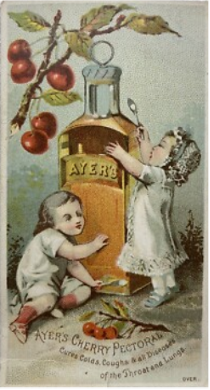
• Ayer’s Cherry Pectoral, an American soothing but potentially lethal mix of alcohol and opium. Supposed to cure coughs, colds, asthma, bronchitis, croup, whooping cough, and consumption (tuberculosis). Supposedly ideal for young children (see right)!
Serving a rural market town like Bishop’s Waltham required catering directly to livestock, horses, and farming needs:
• Livestock Remedies: Horse drenches, "golden ointments" for equine leg ailments, and various cattle powders
• Pest Control and Preservatives: Large quantities of arsenic and strychnine sold to farmers for vermin control, alongside sheep dip, and saltpetre for curing meats.
Finally, toiletries, cosmetics, and domestic goods. No chance was missed to provide luxury and daily essentials while the customer was in the shop:
• Skincare: Hand creams and cold creams made with rosewater, elderflower, almond oil, and oatmeal to protect agricultural workers' skin from harsh weather
• Grooming: Tooth powders, imported French perfumes, scented soaps, and hair pomades
• Household Goods: Baking powders, dyes for clothing, marking ink, and fancy confectionery like lozenges.
By the 1890s, independent pharmacists like John Young were facing newly emerging
corporate chains like Boots of Nottingham, who began a huge expansion of their High Street chain in 1890. So independents tried to diversify by selling:

• Photography Supplies: Liquid chemicals for developing plates, which was a booming late-Victorian hobby
• Tobacco and Spirits: Fine cigars, loose tobacco, and medicinal wines or brandy
• Sporting Ammunition: Gunpowder and lead pellets for local game hunters’ cartridges.
While John offered cures and remedies, Susannah was offering non-essentials – perhaps a perfect combined pitch in two neighbouring shops?
Her “Fancy Goods Repository”:
This would likely have catering primarily to the growing number of middle-class women in this late Victorian period. Even in rural Bishop’s Waltham fashion mattered – as advertised in

local newspapers and magazines. Susannah would have focused on non-essential, decorative, and personal luxury items rather than basic groceries or hardware.
Her “repository” (a grand name usually applied to multi-storey London ‘emporiums’) could have stocked any of the following:
Fashion Accessories & Small Luxuries
• Ladies' Accoutrements: Silk fans, kid gloves, parasols, and ornamental hairpins
• Metalwork Trinkets: Highly sought-after "skirt lifters" (metal grips to keep long skirts off muddy country roads – essential for Bishop’s Waltham streets of the time)
• Men's Gifts: Leather dressing cases, pocketknives, and match strikers.
Needlework, Crafts & Art Supplies
• Haberdashery: Exotic ribbons, coloured silks, ivory bodkins, and Berlin wool work kits
• Art Materials: Sketchbooks, watercolours, and decorative papier-mâché boxes for home painting.
Toys, Games & Novelties
• Amusements: Wooden puzzles, optical toys, and high-quality porcelain or rag dolls
• Souvenirs: Local topographical postcards and "Mauchline Ware" (transfer-printed wooden egg cups, trinket boxes and many other kinds of wooden souvenirs, transfer printed with a line drawing of well-known local sights - such as the Palace ruins - thought by some to have been an Abbey at the time!).
Stationery & Toiletries
• Writing Goods: Embossed writing paper, sealing wax, and decorative inkwells
• Genteel Grooming: Imported French perfumes, rosewater, scented soaps, and ivory tortoiseshell combs.
John and Susannah remained here, running their two businesses until at least 1891, but soon after that John died in the Spring of 1892, aged 73. Susannah then disappears from the records, perhaps returning to Australia in her mid-50s.
1900
John’s death and Susannah’s departure gave rise to another significant change of use for this property, as we know the next business was as the Post Office, run by Lucy Veale.
By 1900, house-to-house mail delivery was taking place across England. In that year there were nearly 22,000 post offices operating across the United Kigdom. Of which 906 were classified as Head Post Offices. These functioned as the head office for their locality and included sorting facilities as well as offering a counter service. Under these were a further 255 branch offices. Finally there were 4,964 town sub-post offices and 15,815 country sub-post offices; these were run by sub-postmasters and mistresses, most of whom were self-employed shopkeepers who were paid a commission for their postal work (in contrast to the counter staff of the larger 'Crown' offices, who were GPO employees). Source https://en.wikipedia.org/wiki/General_Post_Office
Lucy Veale was born in 1863 as the fourth of seven children of Arthur and Sarah Veale, a Commercial Clerk and his wife who were living in Southampton. By 1881 Lucy is noted as a Pupil Teacher aged 17 but we don’t know where. However, by 1891 she is a Post Office Assistant to William Barclay who was trading as a Post Office from the property now (2026) run as Tashinga. She obviously learnt the ropes well as by 1901 she is running the local Post Office from the Madeline House site. She remained there until at least 1915 when she is listed in the local Trade Directory, but she is not listed there by 1920.


The High Street in around 1900 with two men entering the Post Office housed in this building (see close-up).
As mentioned earlier this meant that Lucy was in charge of the telegrams received from the War Office during at least the first year of the First World War. These informed the ‘next-of-kin’, be that wives, parents or sibling, that their husband, son or brother had died or were wounded or missing in action. Once the message arrived at the destination Post Office, it was transcribed personally by the postmistress onto a paper form and handed over to a "Telegraph Boy" on foot or bicycle to hand deliver it. The sight of such a pending delivery sent a chill down all residents’ spines on the street. Whose door would he have to knock on?
At some time between 1915 and 1920 Lucy moved to Richmond, Surrey where she died aged 61 on 12th November 1924, leaving an estate of £129.16s.1d. (£129.80) - about £7,000 in today’s values.
Another photograph from the Bishop’s Waltham Museum collection shows the Post Office relocated to its present site around 1917 (below left).


But the Madeline House site, still under a single awning, now has a massive gas lamp outside. The Bishop’s Waltham Gas and Coke Company had been founded in 1863 and by the following year was supplying gas to the town – making it the first small town in Hampshire to have gas street lighting. So gas was not a novelty and although electricity didn’t come to Bishop’s Waltham until 1932 this seems an extravagant gesture. As mentioned earlier, at some point between 1915 and 1920, the building was taken over by a 25-year-old furniture dealer, Archibald Norris, from Bishop’s Waltham, with his wife, Hilda, from Southampton, as his assistant. Their business occupied the site, again as a single premises until the late 1920s. So it is likely that the big lamp was meant to symbolise the fact that they sold gas light fittings as furnishings.
As a furniture dealer Archibald and his wife would likely have sold lighting as part of the décor. Gas chandeliers (gasaliers), wall sconces, and glass shades were chosen to match the style of the room's furniture. Because lighting was treated as a decorative interior design element, it naturally aligned with the furniture trade rather than just the plumbing trade.
Following the Norris’s furniture shop, other businesses traded from the premises between the wars and immediately after the Second World War but their identity is not known.

A photograph [left] taken in February 1962 shows a single awning over the two shop fronts to protect the butcher’s meat and the sweet shop’s chocolate from the afternoon sun.


Difficult to discern, but the sign above the awning could possibly be a large contemporary Woodbine Cigarette poster and the black machine attached to the shop front (see right) looks like a 1960s cigarette vending machine (see left). A time when the vending machine manufacturers had cracked how to make machines that could sell high price items. Outdoor machines large and small peaked in the sixties before being restricted and then banned to stop under-age purchasers.

Comments